EuroCucina, the biennial exhibition dedicated to the kitchen world, takes place every two years within Salone del Mobile. Milano is back this year from April 21st to 26th, 2026. This year featuring 106 exhibitors from 17 countries, including 35 new or returning brands, the event will showcase innovations shaping the kitchens of the future. Running for over 50 years, with the first event held in 1974, EuroCucina has transformed into the benchmark kitchen event at an international level, bringing together hundreds of exhibitors showcasing a wide range of products. Each edition reveals new visions that highlight emerging trends in design, materials, colours and technologies.
The main concept of EuroCucina this year revolves around the growth and evolution of design language. The exhibit beautifully highlighted the rituals associated with the dining experience, reinforcing the concept of belonging and community that homes continue to crave. Each detail, from colors to technologies, is designed to enhance today's emerging habits. The senior designers of Cuisine BCBG traveled to Italy to explore these new materials, refined finishes, and the latest in custom craftsmanship. The team immersed themselves in the emerging design trends and sourced new elements that will elevate our upcoming kitchen and bathroom projects with even greater attention to detail. In this blog post, we will be going through these novelties with specific examples.
While walking through the streets of Milan early in the morning to enter the Salone del Mobile exhibition, some of Cuisine BCBG’s senior designers couldn’t help but notice a shift in design that is more driven by sustainability, technology, AI integration, and, more importantly, biophilic design. Additionally, more often than not, materials started becoming more tactile and environmentally aware, with color returning in softer shades. Finally, one cannot help but notice a shift from minimalism, seeing more emotional and natural expressions instead of cold and rational ones.
Surfaces & Countertops
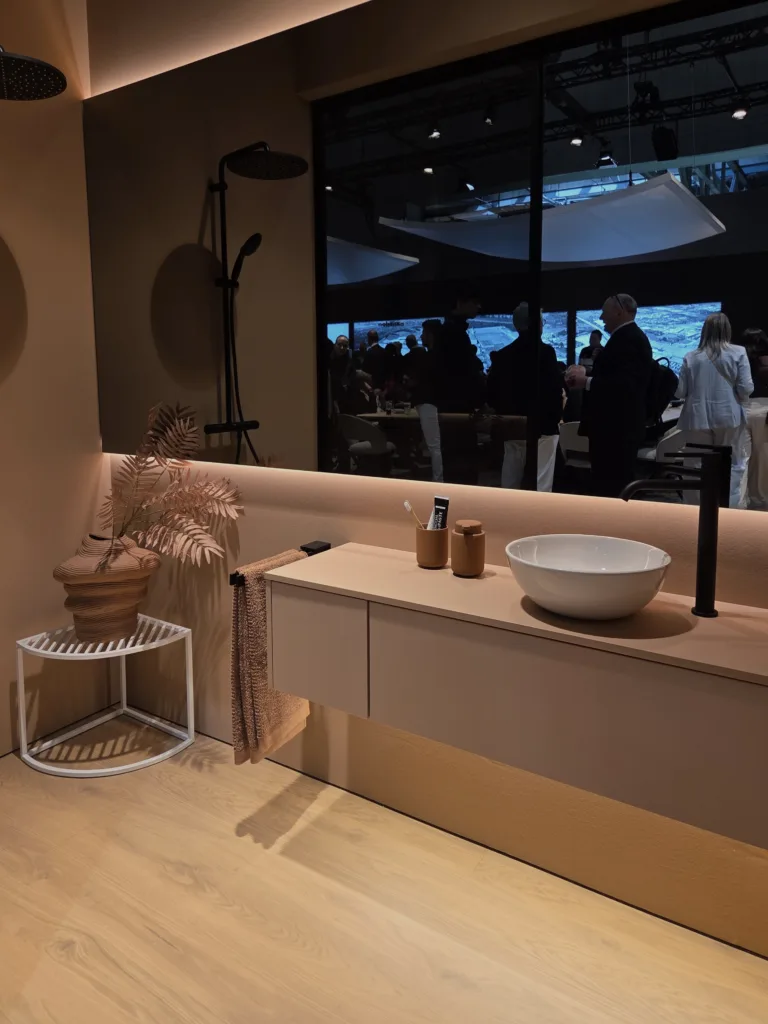 One of the most striking observations from this year’s EuroCucina was the evolution of the countertop, no longer serving a purely functional element, but a design statement. Flush countertops, most notably showcased by Iconica, created seamless, uninterrupted surfaces that blur the boundary between the work surface and the cabinetry itself. The kitchen was created in one seamless colour, a dusty pink hue flowing across the cabinets, counters, and chairs, colour taking over texture to create a new sense of harmony. Waterfall counters took on a new interpretation as well, presented as two distinct pieces, a top and a side panel with a deliberate gap between them, giving the illusion that the stone had been cleanly sliced in two, creating the impression of a 3D effect, as if emerging from the counter itself.
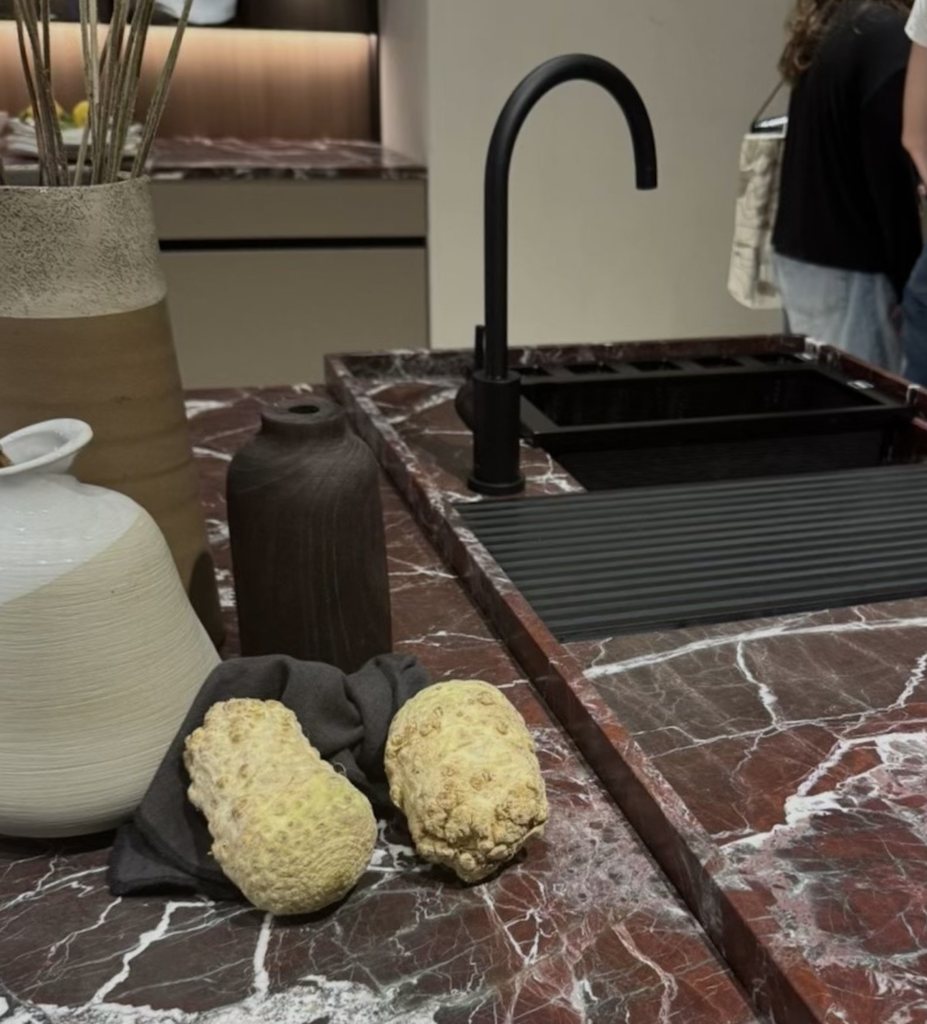
Dekton, an ultra-compact surface that combines raw materials such as glass, quartz and porcelain under extreme heat and pressure, continued to assert itself as a material of choice. The Dekton appears not only on countertops but lining the interior backs of open cabinets, transforming functional storage into something similar to an art installation. Retractable countertops also made a notable appearance, offering a clever spatial solution for those who prioritize flexibility, a surface that tucks away when it’s not in use, making the most of kitchen space. Cutouts and delineations carved into the surface of aisles created distinct zones, one for cooking, one for eating, subtly guiding the rituals of the kitchen without imposing specific and strict boundaries. Thus, making longer aisles feel more intentional and useful in our day to day lives.
Cabinetry & Doors
The cabinet door received a large amount of attention this year, with designers clearly pushing the boundaries of what this element can communicate. To the viewer, hidden and integrated doors were abundant, reinforcing the monolithic aesthetic that continues to gain momentum to this day. The kitchens appear as one continuous, sculptural volume rather than a collection of individual parts. The Blum Revego,pocket door system for example, made a notable appearance in simulated form, while large panel doors with some functioning as pocket doors, defined moments like the coffee corner with a sense of intention.
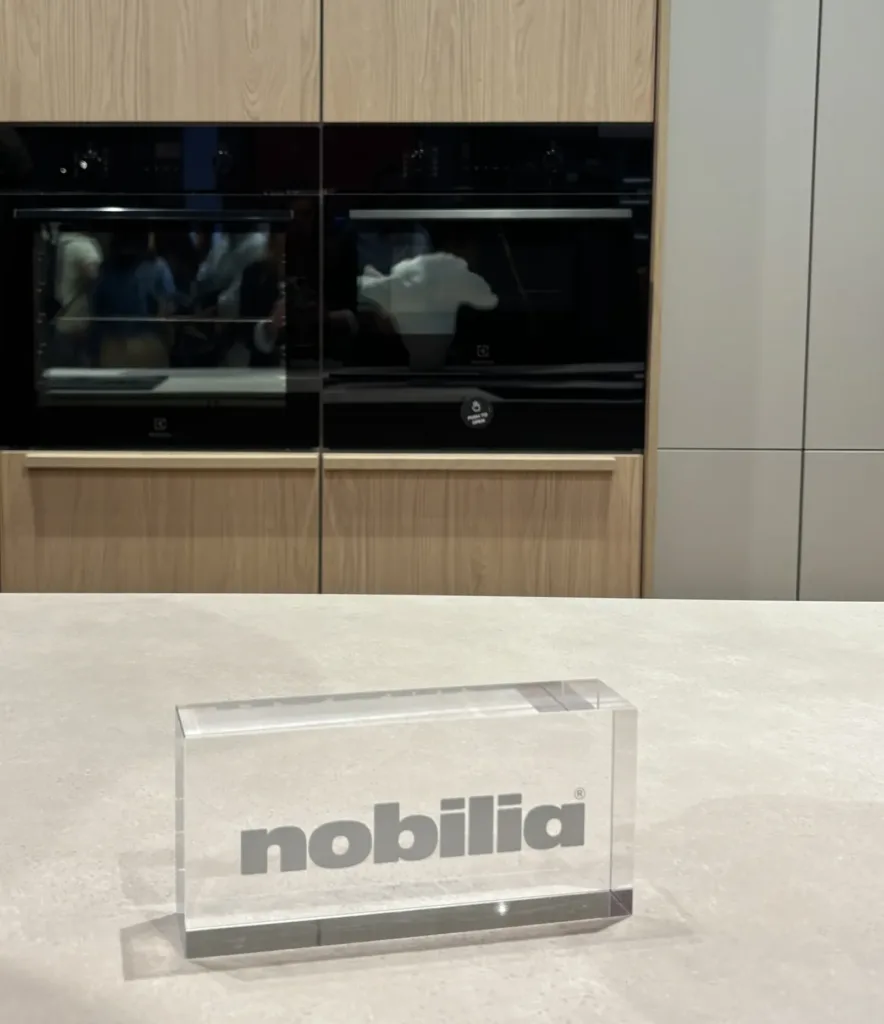
Texture plays a large role when it comes to the door conversation. Patterns and deeply detailed surface treatments replaced the flat, lacquered finishes of the previous years, inviting touch and rewarding close inspection. NobiliaNobilia for example, presented a particularly compelling take, where a small section of cabinetry would pop forward in a different color, in this case a warm beige which is a subtle but powerful disruption of the monolithic surface.
Colors & Finishes
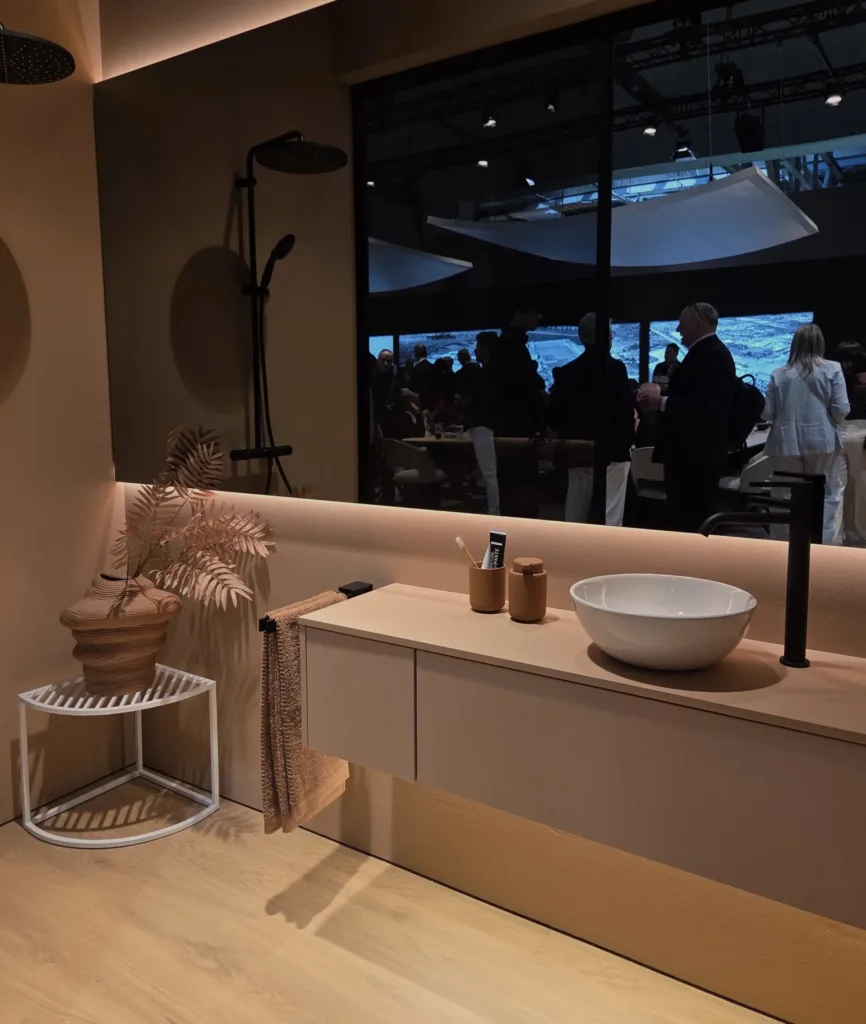
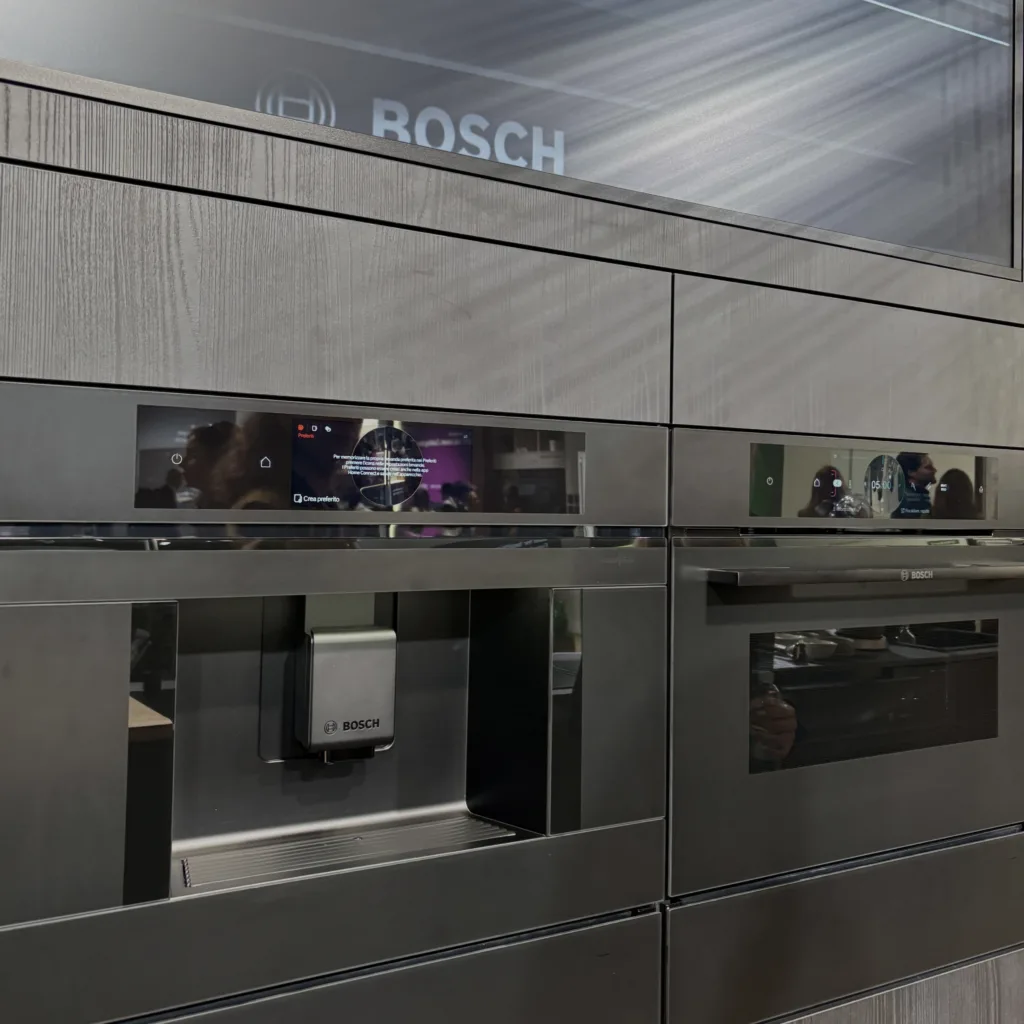 When it comes to colors, we can’t help but notice how color made a confident return to EuroCucina 2026. However, color returned in a far more considered and intentional way than the bold maximalism of the prior years. Tone-on-tone compositions dominated with vanities, mirrors, countertops, and cabinetry unified under a single color story, creating environments that feel deeply cohesive rather than assembled. The finishes were oftentimes matte finishes and everywhere, most beautifully executed on appliances by Bosch, whose brushed black stainless steel and rich surface textures offered a quiet sophistication. Smoked glass, bronzed accents, and layered combinations of thick and thin counters in an all-black kitchen brought to a new level of editorial refinement to the space.
Mirrors & Glass
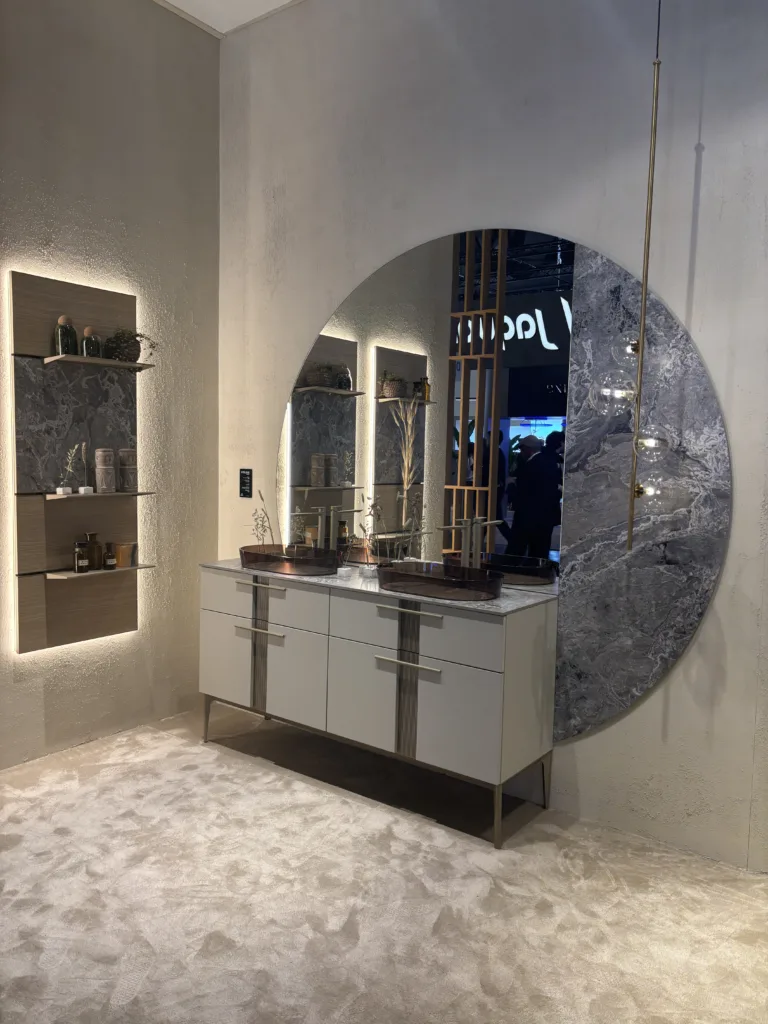 Glass and mirrors took on a large role throughout the whole Salone del Mobile,moving well beyond their traditional applications. Mirrored backsplashes extended deep into the backs of cabinetry, amplifying light and dissolving the perceived depth of the kitchen. Large doors unfolded entirely in glass, while others combined glass panels with metal framing, a detail that added structure without getting rid of transparency.
Perhaps the most innovative detail observed by our designers, was the treatment of the mirror itself: rather than a simple rectangular or circular mirror, designers allowed the reflective surface to transition mid-composition into a complementary material such as marble, stone, or plaster so that the object became a hybrid, part mirror and part artwork. Lit mirrors appeared throughout both kitchen and bathroom contexts, adding a layer of function and ambiance simultaneously.
Lighting
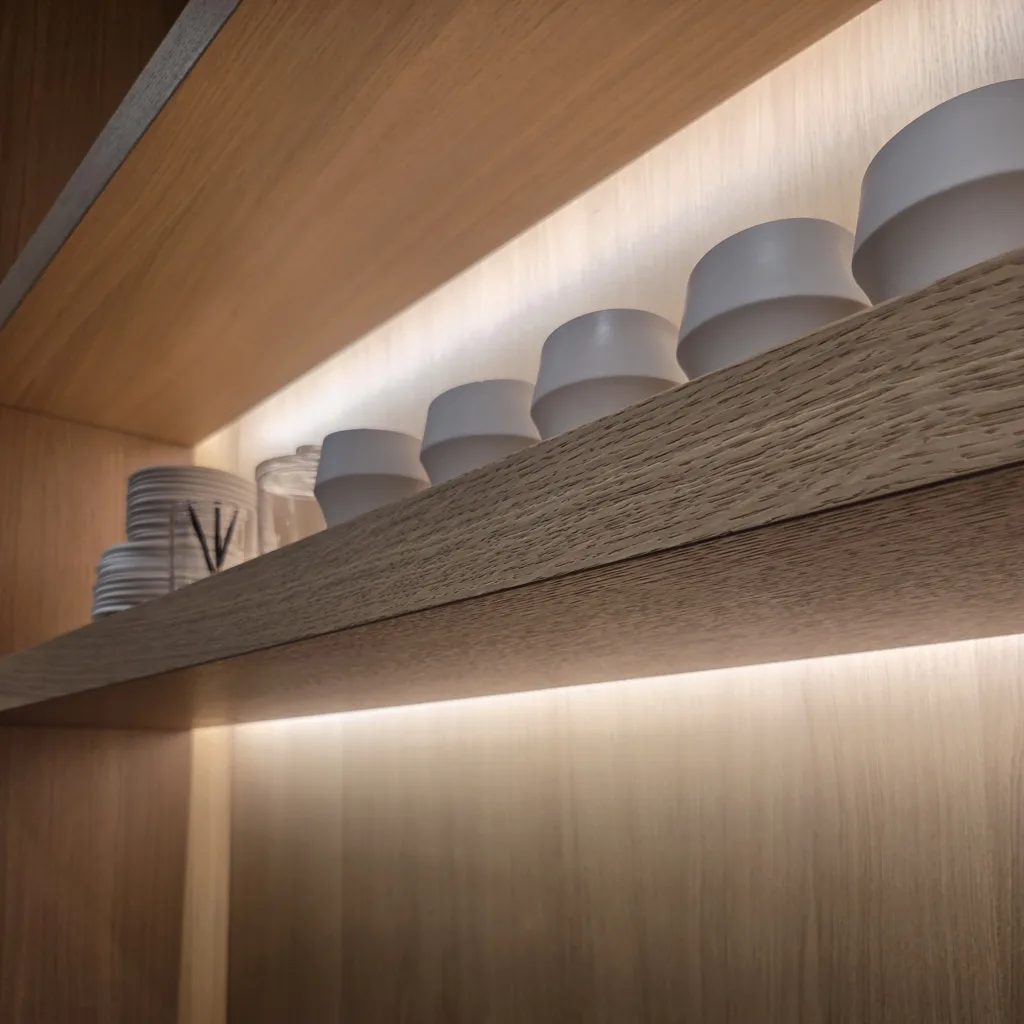
Integrated lighting was also a recurring and refined detail across many exhibitors in the Salone del Mobile, 2026. Drawers illuminated upon opening, storage units glowed from within, and angled panels backlit to cast soft, indirect light across surfaces. Extended shelving with rear lighting created a floating effect, making objects placed upon them appear suspended in light. For the first time, we saw a broader shift away from overhead lighting as the sole source of illumination and instead shifted toward a layered, atmospheric model where light is built into the architecture of the furniture itself.
Shapes & Forms
Curves dominated the formal language of this year’s exhibition in a way that felt deliberate and intentional. Oval shelves, round surfaces, softened corners, and boat-shaped dining tables replaced the sharp, angular geometries that defined the previous decade of kitchens.
Islands evolved beyond their traditional rectangular footprint, with round tables integrated directly at a lower level, creating a natural gathering point that bridges the kitchen and dining experience together. The annexing of a round surface to the island at a reduced height was a recurring solution which was simultaneously functional, social, and visually dynamic.
Accessories & Organization
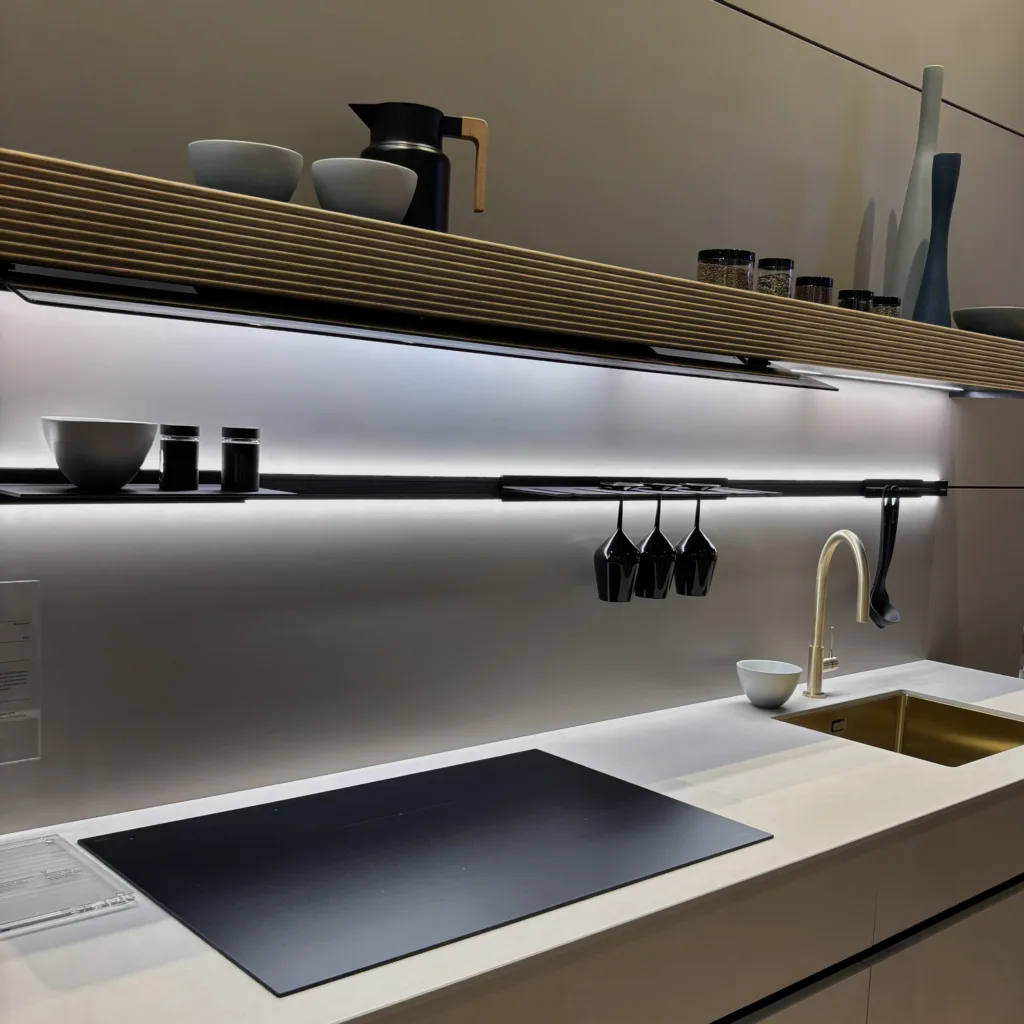
The approach to kitchen organization underwent a quiet revolution at EuroCucina 2026. The traditional closed cabinet gave way, in many instances, to open metal rack systems, modular, movable, and entirely exposed to the eyes. This shift speaks to a generation of users who take pride in their ingredients and tools and who want them visible, accessible, and beautifully arranged. Integrated organizers, compartmentalized racks, and purpose-built hooks elevated the accessory from afterthought to ,intentional design.
Bronze-plated details appeared throughout storage solutions, lending warmth and materiality to what might otherwise be purely utilitarian components. Additionally, Hacker presented what was perhaps the most forward-thinking detail of the exhibition: integrated pivoting outlets and pop-up power points built directly into the island, a seamless solution to the demands of the connected kitchen, with no standard outlet in sight.
Bathroom Innovations
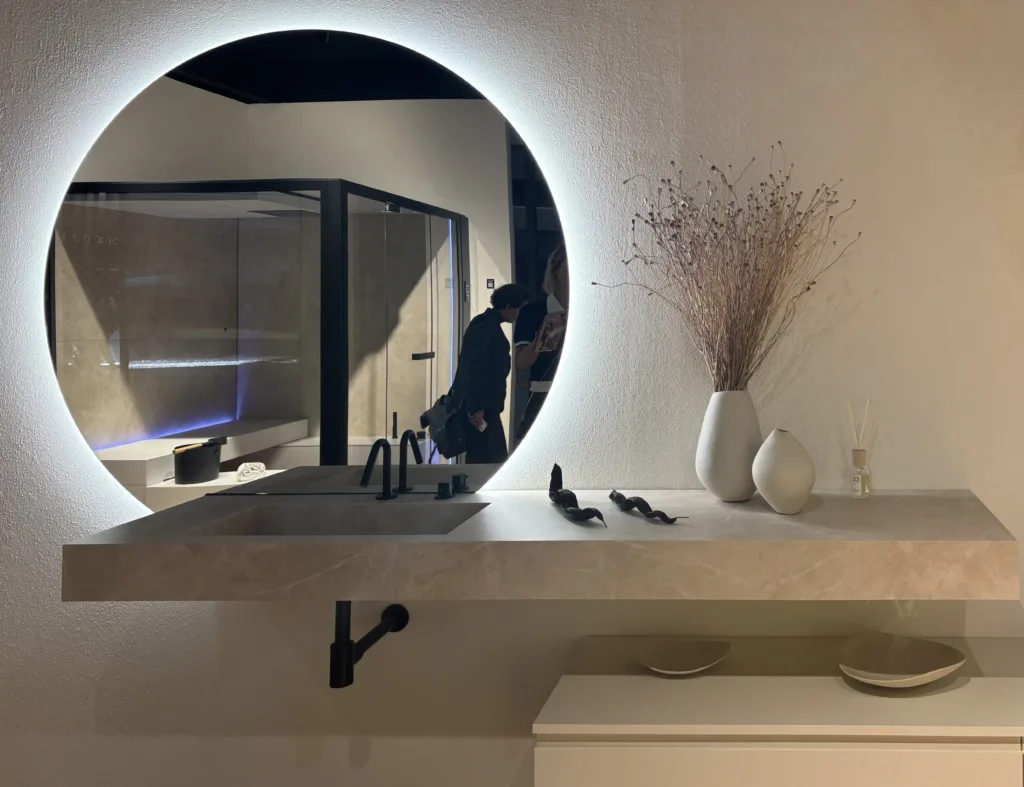
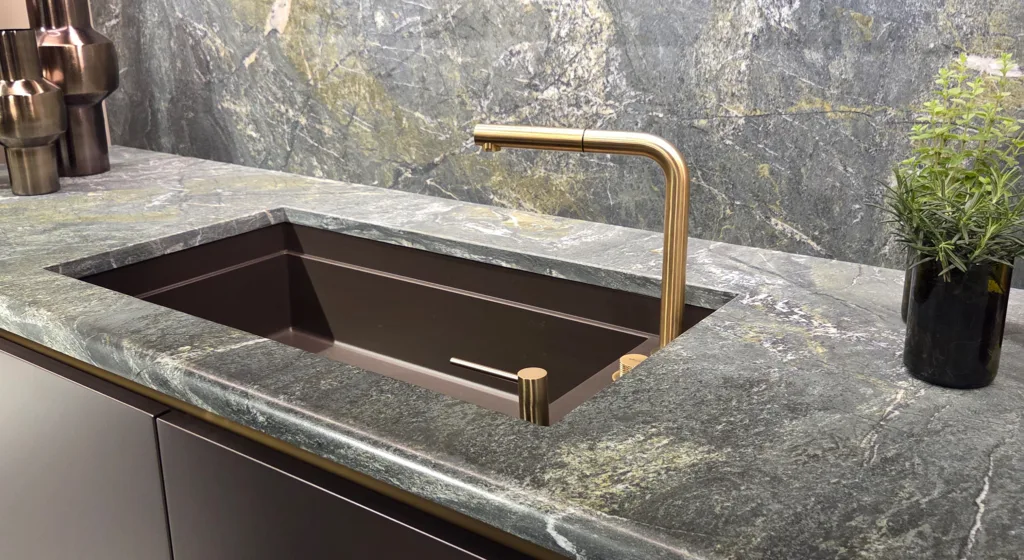
The bathroom, always a counterpart to the kitchen at EuroCucina, reflected many of the same values such as, warmth, materiality, and tonal unity, while introducing its own distinct moments. Natural stone dominated the sink area, with raw and organic forms replacing the polished precision of previous editions. Bronze accessories for the sink appeared across multiple exhibitors, echoing the broader material palette seen throughout the halls.
Storage solutions around the toilet were reimagined entirely, flanking panels that rise and extend upward created a continuous storage environment that made the most of often-overlooked space. Most interesting of all were the mirrors that were deliberately decentered from the sink, a small but meaningful disruption that added asymmetry and movement in the bathrooms. The tone-on-tone principle extended fully into the bathroom context, with one exhibitor presenting an all-orange environment, with the vanity, mirror, walls, and accessories unified in a single bold color statement that was as cohesive as it was unexpected.
Lastly, the final takeaway fromEuroCucina 2026 is crystal clear: the kitchen is no longer simply a place for function, instead, it is a space of ritual, culture, and identity, and the design world is responding with unprecedented depth and intention.
With that, the team at Cuisine BCBG looks forward to bringing these novelties directly into your next project.